Followers

Sunday, 6 May 2018

FOOD TRAILS OF GUJARAT

Gujarat is a foodie’s paradise. And we challenge you to finish reading this article without drooling over all the goodies we talk about here. Gujarati cuisine is an eclectic mix of spices, condiments, and loads of sweetness. Primarily vegetarian but believe us your taste buds will not miss the meats at all. The cuisine changes every few hundred kilometres but then that is true for the entire country - cuisines and dialects change every few hundred kilometres in our country.


When in Ahmedabad


The sweet and the tangy


Jalebi
The city has many food hubs including Law Garden and other markets. Not just the authentic Gujarati dishes but also the experimental fusion foods - you can let your taste buds explore every thing. Start with the "Baap" of all experimental food joints - go to Manek Chowk for a flavourful dinner. Be ready for a culinary experience like no other for an extended dinner here. Manek Chowk is in the heart of old Ahmedabad city and is a bustling square which has different markets at different times of the day and night, this place never sleeps. Post late evening, the area is a bustling food court with fusion foods as its main highlight and charm. Indulge in some chocolate and ice-cream sandwiches and all types of kulfi - even a masala kulfi. It is an experimental and eventful food bonanza. Try some pasta dosas, double cheese pizza, pizza with Indian and Chinese twist, different kinds of bhel, all types of chaats, street food from all around the country and for those who have a sweet tooth - indulge in some rabri and jalebi or malpua. You name it and they have it! Top it all up with a tall glass of buttermilk so that the stomach is ready for the next day’s delights. When in Gujarat you can’t do justice to all the toothsome foods in just one day, you definitely need at least a week.


Fafda with raw papaya condiment and kadhi
The next morning you must go for the famous Heritage Walk. The walk culminates at Jami Masjid which is close to a century old Chandravilaas restaurant that serves the most amazing Jalebis and Fafdas. Have a sumptuous breakfast here. Fafda Jalebi is a must have, you may also choose from Khaman, Dhokla, Khandvi, Handvi, Thepla and finish it with a Masala Chai. The place boasts of such clientele as Mahatma Gandhi, Sardar Patel, Kishore Kumar, Dev Anand among many other famous personalities. Proceed for city sight seeing tour after your breakfast.


Next meal has to be another culinary delight. Finish your sight seeing, return to hotel and freshen up for yet another Gujarati speciality dinner. Dinner has to be the world famous Gujarati thali at Gordhan Thaal. The place has a long waiting on weekends but it is always worth the wait. The thali as the name suggests is an authentic Indian platter with many small bowls in which you would be served Undhiyo, Kadhi, Dal, Mixed Vegetables and Basundi. Dry snacks known as "Farsan" usually consist of Kachori and Dhokla. Assorted breads, rice and salad will accompany. Buttermilk to help soothe your stomach. An expert advise here - never say no to buttermilk, it always evens out anything that your stomach did not like despite your taste buds going gaga over it. A few bowls of Basundi or Aamras in summers has never done any harm to anyone.


Let’s go to Bhavnagar


Bhavnagari farsan is famous world over. There is something definitely very special about the namkeens made in Bhavanagar else how would they be so crisp and addictive. You can’t stop at a few, you need to have a couple of bowl-fulls. Gathiya, sev, khakhras and all types of dry fruits - deep fried. Takeaways can be half a kilo of sev to a truck load of all types of farsan. The amazing fafdas come in box like packaging that prevents them from getting crushed. But gathiya are the most popular snack that is even exported from Bhavnagar.

Gathiya


Surti street food

Surat is the diamond polishing hub of the world. What a lovely city - has everything one can want. There are beaches and there are rivers, there is the best wholesale fabric market and then there also is the diamond polishing bazaar. And to call it the destination for the best street food in the world is no exaggeration. It is a foodie’s paradise. Walk along any popular market and the lanes are packed with food vendors selling street foods from around the world - there is Mumbai's Vada Pav and Dilli's (Delhi's) Chaat, Mexico's Tacos, China's Chowmein, Italy's Pizza and America's Burger! Let us just list down a few of these items for you : 
Locho - a modification of khaman served with different sauces. We recommend “Gopal Locho Khaman House” for an authentic experience.

Locho

Surti Khamani - Made from chana dal and garnished with tangy chutneys and crispy sev. 
Ghari - a sweet dish like no other is all we can say. 
Undhiyu - Surati version of the mixed vegetables but definitely much superior in taste. 
Bhajiyas - call them pakoras (fritters) and you will know what we are referring to here. 
Ponk Vadas - A very seasonal dish available for a few days in winters only. It is not only healthy but also very very tasty. Made from fresh Jowar this snack is a must-have. 
Ponk Vada

Collegian chaat - Does the name not say it all? All college goers know about it and it is one of the most popular snacks among the student population of Surat. Main ingredient is peanuts - healthy and filling. 
Nankhatai - Any baker would tell you that nankhatai isn’t just another cookie, it is a celebration in itself. Get the best ones from a two hundred years old bakers - Dotivala Bakers and Confectioners. 
Ice Dish - The ice gola got a makeover and became Ice Dish! Crushed ice topped with vanilla ice cream and fresh cream and nuts and flavoured squashes - thats the sinful ice dish for you. 
Rassawala Khaman Dhokla - Yes, add spiced up gravy to your regular dhokla and you get this amazing curry. Have it just like that or with Pav or roti or rotla. 
Egg Paratha - Your Frankie as the egg roll is called in Mumbai became egg parantha in Surat and got a little more spice and a little more butter to make it tastier. 

Surat should actually have a separate blog post dedicated to the street food of Surat. Life in Surat can never be boring.


The Parsi Food Trail - Udvada  

Udvada Atash Behram

The closely knit peace loving community preserves its heritage so beautifully that we recommend a visit to Udvada to one and all. Walk through the quaint and peaceful town clicking pictures of heritage homes. The famous Atash Behram Fire Temple or Agiyari as they call it is an architectural marvel to behold. Non-parsis are not allowed inside the temple but you can click many many pictures of the facade from outside. Parsis’ cuisine is very unique and so different. There are some old cafes and hotels here where you can taste the very original and authentic Parsi food. The world famous dhansak, mutton pulao and papeta tarelli chicken need to be devoured with full greed. Other specialities include khurchan - dry roasted spicy organ meat, patra ni machchi, crispy chicken farcha, fluffy Parsi omelette, dudh na puff and for the dessert you must have lagan nu custard and hand churned ice cream in the seasonal fruit flavour - mango and seetaphal being the most favourite. 

Nankhatai


Welcome to Vadodara


Once you are done with visiting the world famous Laxmi Vilas Palace and other sight seeing, it is time to indulge in the butter-rich street food in Baroda / Vadodara. Best places to eat obviously will be found near the university campus. Try the egg preparations - omelettes, not-so-French French toast, spicy anda bhurji and the evergreen most loved boiled eggs. Another popular food item from Baroda is the Bhakarwadi, a twirled savoury snack - spicy and tangy. Baroda has a lot of Maharashtrian influence and hence Vada Pav and Misal Pav also are quite popular here. Like Ahmedabad, Baroda too has lot of fusion food stalls all around the city. Do sink your sweet tooth in the falooda ice cream after your eggy dinner.

Street Food - Vadodara


Operation Flood 

Milk lovers, you all know about the revolution called Operation Flood aka Amul that started from Anand and swept the whole country, inundating the lives of all Indians with milk and nourishment. Immerse your taste buds in flavoured milk, ice creams, cheeses and Shrikhand. You can find Amul anywhere in Gujarat and in the rest of the country too. But so many flavours of Shrikhand can only be found in the land where Krishna, the God who loved cows and milk, is worshipped. Oodles of butter and creamy fluffy Shrikhand must go with every meal. Indulge in the goodness of this health food. Visit the Amul factory for freshest chocolates and ice creams.

Shrikhand


The indigenous burger : Kutchhi Dabeli

A Gujarat trip is incomplete without a visit to the Rann of Kutchh - the white desert. Kutch is also famous for its very own version of burger - The Dabeli. A soft bun, filled with squishy spicy potato filling, topped with nylon sev and chutney and roasted peanuts, main attraction being the ruby-red pomegranate seeds. These come with a warning : NO ONE CAN EAT JUST ONE!
Kutchhi Dabeli


Jamnagar Ghughra

Ghughra
Popular street food from Jamnagar is Ghughra which is a deep fried “Gujiya” shaped snack. The fillings are usually made of chana dal or spiced potatoes. Crispy and spicy - a perfect evening snack with your hot cuppa!


Porbandar Khajali 


Khajali is a kind of spicy deep fried biscuit. Best paired with hot beverages like masala chai, it is an irresistible and addictive snack. While you are picking up your supply of Khajali, you must visit the spice market in Porbandar too. Porbandar is Gandhiji’s birthplace and Kirti Mandir, the Mahatma’s home is a must visit site here. Also visit the Sudama Mandir and Bharat Mandir.


Khajali


What to carry for friends and family


Fafdas, Khakhras and Nan Khatai of course! Then there is Bhavnagari farsan, bhakarwadi and dry fruits. You can also pick some ready-to-make mixes of khaman and dhokla and make them later at your home. For fafdas and khakhras we recommend Induben Khakhrawale though these are available all over Gujarat and are promoted through cottage industry. A packet of Porbandar Khajali will slip in easily in your luggage. Another popular snack that can be carried along is the Chorafali, deep fried spicy fritters of besan and urad dal. 

Khakhra


If you are a food blogger, a food photographer, a food connoisseur, a food critic, a food technologist or in simple words, if you LOVE FOOD, take a food trail across Gujarat with us and savour the many flavours the vibrant land has to offer.  


Images sourced from : Flickr, Pinterest, Maps of India, Youtube, Indiamart


Plan your food trail - click here.

Thursday, 26 April 2018

A guided tour through The City Palace, Udaipur

One of the most magnificent palace complex in the world can not be toured without a guide’s help. Why? Because, you don’t want to miss out on any interesting facts and stories that a seasoned guide can regale you with. The palace I am talking about is the marvellously built City Palace in Udaipur. As you ascend the gradient towards the complex, you are transported to an era where horses and elephants walked the path you now are treading. Enter the main gate and you would be informed how the complex is divided into four parts - The palace and museum, Two ultra luxurious heritage hotels - Shivniwas Palace and Fateh Prakash Palace, and The private residence of the erstwhile ruler of Mewar where the erstwhile royals still reside. 


Let's tour the palace and the museum. The Suryavanshi’s palace, the descendants of Lord Rama’s son Luv, have a huge image of The Sun God right at the entrance of the palace. The interesting fact is that, every morning every citizen and the ruler too paid their obeisance to the Sun and for days when the Sun would get obscured by clouds, they had these large images to pay their respects to - one inside the palace for the Maharana and the other outside the main gate for the citizens. The family history of the rulers of Mewar with brief introduction of each successive ruler is given along the path that leads into the palace. Enter the palace and you are greeted by Lord Ganesha himself, in a tiny temple right at the entrance.


All over the palace you would spot vintage tiles and stained glass imported from Belgium, China, Europe and many other places adorning the walls and windows, a few doors decorated with ivory too can be seen. The huge palace was built over many centuries (we are talking about 400 years here !!) with each successive ruler adding his own bit to the existing complex. The first part of course is where Maharana Udai Singh Ji, the founder of Udaipur resided, this being the simplest residential quarters with minimalistic decorative architecture. The complex has Indo - Sarasenic architectural influence.

As we ascend the steps after marvelling at the personal weaponry used by Maharana Pratap and a life-size replica of his favourite mount Chetak, we reach the place where a newly coronated Maharana would sit for the public to get a first glimpse and would throw gold and silver coins from the little window as gifts for the citizens. The tub used for storing these coins is larger than most jacuzzis! Walking on, we reach a courtyard where tall trees provide shade and serenity around a beautifully manicured garden. One wonders which floor would one be on, since there were lots of steps that one has taken to reach here but the presence of the large trees suggests something else. Well, another interesting fact here for all to know - the palace is built over a mountain without the mountain being levelled. The whole mountain was encapsulated inside a beautifully built fortress wall, all painted white. From outside it looks like a magnificent fort with many many floors inside but as you ascend the steps inside you realise you are on a mountain and not a building which has many floors. Isn’t that just amazing?
Another interesting fact to know is that the Maharanas never attended any courts other than the ones they themselves presided, be it the Mughal or the British courts. Hence after the merger of the Mewar state with the British Union, the empty chair that was kept for the then Maharana was sent to him as a gift of respect by the British along with two thorough-bred horses - the chair being an exhibit that you can see in the palace museum. Take a look at the city below from the heights that you have now ascended to, soak in the sights before moving onto the residential quarters of the Maharanas which are decorated with mirrors and gold and exquisite colours. The opulence and class, the taste and the extravagance, the true royalty of yore is here for you to see and experience. Hand painted walls and ceilings where stories are painted, many imported decorative glass pieces and tiles, ivory doors, - words aren’t enough to express the richness of this palace. 


Moving on, you would cross one beautiful corridor after another and one narrow stairway after another to reach the entertainment arena - The Mor Chowk. Mor- the peacock themed courtyard was the entertainment place where the royals sat all around, one floor above, and dancers and musicians entertained them below in the courtyard. Interestingly, the Maharana’s seat is a few inches lower than the guests’ seats in keeping with the tradition of “Atithi Devo Bhava” (Guest is God). The Lake Palace which is an ultra luxurious hotel now, is visible from many windows of the city palace. The palace also houses an elevator which was built for Maharana Bhupal Singh Ji who was differently abled. Not just that, there is a specially made wheelchair and an imported toilet seat that are exhibited in his residential quarters. The elevators are in perfectly working condition and are used for wheel chair bound tourists for them to get a glimpse of the most beautiful part of the palace.

As we move on, we see the many exhibits including the utensils, palanquins, armoury, cradles, silver ware, statues, musical instruments and a collection of a very many trophies. Us, the dazed tourists, walk along the Ladies quarters and approach the exit to the complex but this isn’t all that is there to see. Walk towards the ancient Jagdeesh Temple and see the elephant stables along the way and the Torans that look like large ornamental open gates - eight of them. A Toran was built each time a Maharana took a pilgrimage and returned. The Jagdeesh temple is built outside the palace complex but has been raised high to bring it to a level where the Deity would be seated higher than the King - another important fact to know.


One more very important fact that intrigues is that the passages and stairways are quite narrow and the entrances to the private quarters are through small doorways. What could be the reason? Any Guesses? Well, the answer is very interesting again! The small doors ensure that one must bow and enter - a symbol of respect to the Maharana, also in case of a siege attempt, the enemy would also bow and enter least expecting a warrior attacking him with a sword decapitating him in one strike! 


There is so much more to The City Palace and Jagdeesh Temple that words aren't enough. One must take out time to visit the Palace at leisure, spending time appreciating each feature and feeling a part of the era gone by! I have visited this marvel twice and will not miss another chance if it comes by.


Thursday, 5 April 2018

PUSHKAR MELA


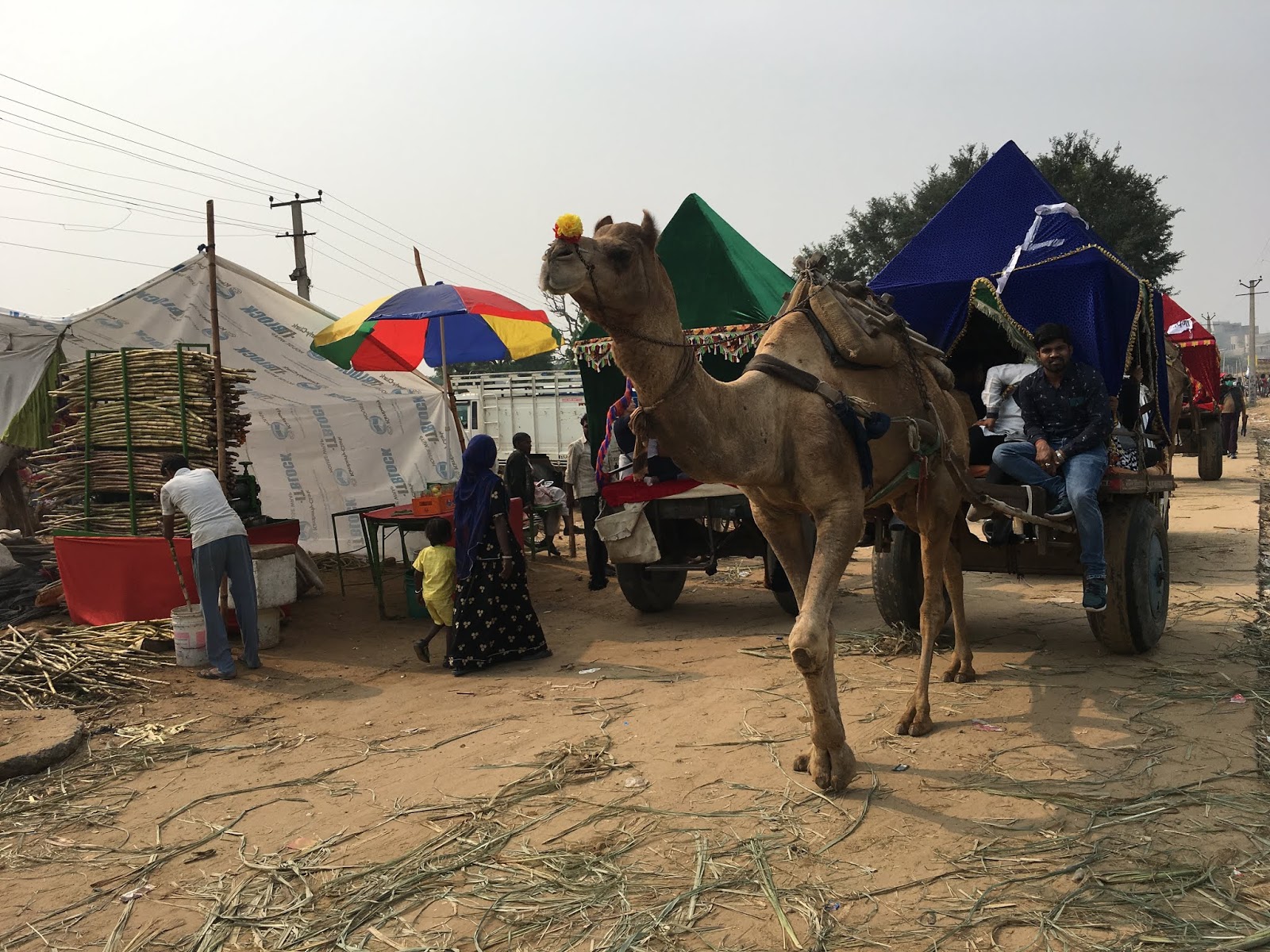
Rajasthan, the land of fairs and festivals is famous world over for the eclectic, vibrant and most colourful fairs that are held all the year round. Each fair has a central theme that it revolves around and has its own significance too. But Pushkar Fair sure wears the crown when it comes to the popularity of these fairs. Not just is the fair popular among the village folks who come here for religious reasons but also among farmers and animal traders who visit the fair to trade into cattle and livestock. But the star of the “Pushkar Mela”, as it is referred to in local parlance, remains the ship of the desert, the camel! Read on to take a tour through this amalgamation of colour, culture, tradition, celebration and festivities.


Pushkar is a sacred town situated 530 metres above sea level in the enchanting valley of the Aravali hills. It is about 11 kilometers northwest of Ajmer in Rajasthan. The holy town has a central lake , The Sarovar which is surrounded by as many as 500 temples all around. But the most important temple here is the one dedicated to Lord Brahma, The Creator God in Hinduism. In fact, till recent times it was only in Pushkar that one could find a Brahma Temple, now though a couple more have been constructed elsewhere too. The lake is about ten meters deep and gets its water supply from the rains. It is surrounded by mountains on the three sides. The Hindu Scriptures describe Pushkar as "Tirtha-Raj" – the king of pilgrimage sites related to a water-body. The Pushkar Lake finds mention on coins as early as the 4th century BC. Pushkar Lake is surrounded by 52 bathing ghats (a series of steps leading to the lake), where pilgrims throng in large numbers to take a holy dip, especially around Kartik Poornima when the Pushkar Fair is held. A dip in the sacred lake is believed to cleanse one of sins and cure skin diseases.

A Pashu Mela or the animal fair is also held at the same time as the 'Pushkar Mela’. The fair is held from 'Kartik Shukla Ekadashi' (11th day of the moon) to 'Kartik Purnima' (full moon night). The Kartik Poornima is of utmost importance for people who visit Pushkar for a religious reason. The water in the lake on this day is considered to acquire miraculous healing powers and people throng the ghats to take a holy dip. It is believed that any ailment or disease gets cured if one takes a dip in the lake on this day.

The local Govt. authorities organise events on each day of the Pushkar Mela. The calendar of the events is released a month in advance from the date of the commencement of the fair. There are fun filled races held for each section of the society. While the women can run with a pitcher of water in the matka race, the men can proudly show-off their moustaches in the moustache competition. Musical evenings enliven the atmosphere of this quaint holy town which buzzes with life during these 9 days of the famous Pushkar Mela.

The stadium in Pushkar turns into the arena for these multi cultural programmes. Classical dancers, folk dancers, Drum and Nagada Troupes, Dancing Horses and Camels, Sufi singers, folk singers all vie for a spot under the arch lights of the magnificent stage set up for the Mela in the arena. Of all the activities that are organised here, the maximum draw is of the Dulha-Dulhan Show where tourists are encouraged to participate dressed as Indian groom and bride and compete for a prize. Another crowd puller is the turban tying competition where men compete to tie that perfectly perched turban in as less time as possible.

Pushkar attracts crowds from all across the world, some come for religious reasons, some for buying or selling camels, horses, cattle and other household and farming wares, but there is a big number of tourists who flock Pushkar to witness this extravaganza of fun and frolic going hand in hand with business. Photography walks, heritage walks, culinary walks and shopping walks are the usuals for the tourists along with henna tattoo making, yoga classes, art classes, cycling excursions, horse riding and camel riding with camel cart riding as well. You would meet the masquerade champs too who dress up as Indian Gods and Goddesses and will oblige you with a picture for a tiny treat or a paltry cash reward. 


Evenings at Pushkar are enchanting to say the least. Colourful play of reflected lights on the still water of the lake, reverberation of Aarti, bells and conch coming from afar skimming the waters to reach your ears, hunger-inducing aromas wafting through the air and people with a skip and dance in their feet everywhere - that’s a Pushkar evening for you.

A shout out to the foodies of the world to savour mouth watering Maal Puas and traditional Dal Bati Churma. There’s Falooda, Lemonade, Chhaas and Ice creams to keep you cool during the sunny days. Hot Jalebis and Rabri, Samosas and Kachori with Kadhi make for a fantastic breakfast or evening snack. The many restaurants by the lake and in the market also serve up international favourites like Pizza, Pasta, Falafels, Tacos and the likes. And the masala chai with a liberal amount of milk is a must-have.

When visiting Pushkar, the must dos include participating in one of the fun events in the arena, observing the nuances of animal trading, savouring the local flavours, paying your respects at the Brahma Temple, spending a quiet evening at the ghats observing the goings around and very important (!) , stock up your collection of leather bags and multi hued bangles made in lac (lacquer).

Pushkar is the Festival for you and me and everyone!


Sunday, 25 March 2018

Twin Pilgrimage - Dwarka and Somnath

Jai Shri Krishna! This is how most of the Gujaratis greet one another. Aptly enough, for the land of Krishna will have his name echoing everywhere. Char Dham - The four main pilgrimages in Hinduism and out of the four, one is the Divine city of Dwarka. 

Dwarka - God's own preferred divine land

Calmly perched on the shore of the Okhamandal Peninsula and lovably cupped in the caressing palms of the Gomti river is this small and peaceful holy city. Filled with tranquility, peace, and serenity and dotted with hundreds of temples the city was built around 2500 years ago.


Many a legends are woven around the city and the most interesting one explains why there isn’t any source of fresh water available here, why the municipality of Dwarka city has to call for water trains and tankers from other places to fulfil the daily requirement of drinking water for the city. The legend says that the city was cursed by an angry Sage. Here goes the story, in brief - Lord Krishna and his wife Rukmini were pulling the chariot for Rishi Durvasa, the saint known for his short temper, to bring him to Dwarka for a feast on occasion of their marriage. Rukmini being a dainty princess got tired and thirsty on the way and Krishna brought Ganges to quench her thirst by prodding his toe in the ground. Rukmini drank the water but the Rishi sitting in the chariot took it as an insult as she did not offer the water to him first. He cursed Krishna and Rukmini that despite being married, they would not have the bliss of togetherness, and hence the temples of Krishna and Rukmini are also at quite a distance from each other. Another curse by Rishi Durvasa was that Krishna’s capital city will not have any source of fresh water and hence no vegetation too. Surprisingly enough, there isn't much that grows here, nor are there any coconut trees also despite Dwarka being a coastal town. The reason for Dwarka having low or no vegetation is the high salinity of the soil here.


The visitors usually arrive during evening hours after a drive from the nearest airport (Jamnagar) / railway station (Dwarka) and straightaway check in to their hotels. After a quick bite and a little rest, they leave for the temple visits. Let's begin at the main temple of Dwarkadhish himself (Lord of Dwarka, Shri Krishna). One of the many pandits inside the complex would offer to be your guide for a fee “as per your wish” and that too, not compulsory. Our guide was a tall, fair skinned, doe eyed pandit ji all dressed in bright yellow and white. He regaled us with the stories associated with the temple with much drama, slowly closing and opening his almond shaped eyes while narrating. There was something about the way he dramatised his story-telling that it left an everlasting impression on all of us listeners. A visit to the temple is incomplete if you do not engage a guide to tell you interesting anecdotes and history of the temple.

It is believed that the temple was built by Vajranabh, great grand son of Lord Krishna. The temple is beautifully carved out of limestone and is still in pristine condition with very little signs of erosion. The tallest Shikhara of the temple is 78.3 m high and is right above the Garbha Griha where the deity is housed. The temple complex is spread over a large area, with many smaller temples built within the complex. The shikhara is adorned by a flag which has the Sun and the Moon on it. The flag is changed five times a day, a different colour each time.

A short walk around the complex and one sees many smaller temples, a kirtan hall and a display of a collection of Shivalingas made out of precious stones. From here, there is a descent down to the Gomti Ghat - another divine experience! We reached the ghat at dusk and were spellbound by the sight of lit diyas floating in the river. Beautifully lit clean water of the river, confluences here with the salty greenish water of the ocean. Such a demarcation of colour and temperature of water, that this definitely needs to be experienced by all those who visit Dwarka. As we ascended the steps again and were on our way out, our guide took us to Maa Devaki’s temple which is located right in front of the main temple and the idols of Dwarkadhish and Maa Devki are facing each other with a direct line-of-sight. The Lord in Dwarkadhish temple is depicted in his child avatar and it is believed that Maa Devaki is constantly watching over her little child from her own temple. After this holy experience, we thanked our well informed guide and left for a little walk by the sea. Dwarka is home to many cows and you will meet them at every nook and corner of the town, by the sea shore too. The many temples that we visited the next morning included, Mata Rukmini Temple, Gayatri Temple and Nageshwar Temple, the last being one among the twelve Jyotirlingas.

A visit to Dwarka is incomplete without visiting the island temple of Bet Dwarka. We unfortunately were running on a very tight itinerary and could not spare half a day for the island visit. This gives me a reason to return to Dwarka and experience the tranquility of the holy town once again.


Dwarka and Somnath are normally visited as a twin-pilgrimage by pilgrims. After Dwarka, we were headed for another divine experience at the indomitable Somnath Temple - a true example of "It does not matter how many times you are knocked down, what matters is how many times you get up!". The coastal road from Dwarka to Somnath offers one of the most scenic drives in the state, with wind mills and occasional glimpses of the ocean along the way. Porbandar, Gandhiji’s birth place is on the way and is always recommended for a brief stopover. A quick visit to the Mahatma’s home, Sudama Mandir and Bharat mandir and you are on your way to Somnath via Veraval. Veraval, other than being a boat repair centre is also of religious importance to Hindus as the place where Lord Krishna is believed to have renounced his mortal form. There is a temple that is built at the spot. The legend has it that Lord Krishna was divinely shielded from any physical harm except on the soles of his feet. As he was resting under a tree here during an afternoon, a Bhil mistook his foot for a deer and shot an arrow which fatally struck him in the sole of his foot. There are other temples also on the way to Somnath, including the Triveni Sangam - the point of confluence of Hiran, Kapila and Saraswati rivers.

Somnath - The mightier than the Mighty!

Standing majestically tall by the seashore is the Somnath temple. It takes a while to soak in this stunning view. Beautifully built temple against the backdrop of the soaring roaring ocean! The symbol of indomitable spirit, rising from the ashes again and again, yes, eight times! The temple has been attacked and destroyed seven times and built and re-built eight times. The temple that now stands was constructed under the guidance of Sardar Vallabhbhai Patel. Believed to be the first of the twelve Jyotirlingas, it is a major pilgrimage site for Hindus. Jyotirlingas are considered as the places or sites where Lord Shiva appeared in a divine form, as a column of fire in Somnath as is believed. The shape of a lingam represents an infinite stambh or a pillar symbolising the omnipotent and omnipresent divinity.


The beautiful temple complex is definitely a must visit for everyone. Immaculately manicured gardens surround the main temple. The cool sea-breeze, the chants of mantras, the sound of the bells and oceanic waves and the spotlessly clean surroundings of the temple, make for a heady and divine experience. Pay your obeisance at the “holy Darbar” and go around the temple for a slow and leisurely parikrama. Walk along the neatly laid out walkway along the mighty Indian Ocean and let your breath get in sync with the waves lapping against the temple foundation. Feel one with the universe while you gaze at the horizon far away. Stay for the light and sound show at the amphitheatre behind the temple and do not forget to buy the chikki and laddoo prasad from the temple shop. On your way out, visit the small Ganpati temple on the left, have a drink of fresh cool water and leave with a feeling of eternal bliss.


Image source : Wikipedia, somnath.org, Tripadvisor and Gujarat Tourism as photography is prohibited in these temples.

Friday, 16 March 2018

Gangaur Festival

Rajasthan is a land of many Fairs and Festivals, each one more flamboyant and pompous than the other. Gangaur which is celebrated in Chaitra is one of the very important festivals here and is celebrated by the women folk. Married, unmarried all ladies celebrate Gangaur with much fervour and zeal. The festival is celebrated all over Rajasthan and West Bengal too. People from Rajasthan who migrated to West Bengal many many decades/centuries ago, carried their traditions, culture and festivals with them. Now Kolkata-Gangaur is also more than 100 years old.


The word Gangaur is a compound word and is formed from “Gana” and “Gauri”, Gana being Lord Shiva the deity and Gauri, his wife Goddess Parvati. This is a festival of spring, harvest and marital fidelity. Unmarried girls celebrate Gangaur seeking blessings for a good husband. Gangaur is celebrated in the honour of Goddess Gauri, who is considered as the symbol of virtue, devotion, fertility and an epitome of the perfect married-woman. Gangaur celebrates the union of the two and is a symbol of conjugal and marital happiness.


The festival commences on the first day of Chaitra and goes on for 18 days. Women fast during these 18 days and eat only one meal a day. The festival culminates into a bigger celebration with much fanfare. Processions of Gauri Isar are taken out with local bands playing and camels, elephants, horses and folk dancers escorting this procession.

Festivities : Clay or sometimes wooden idols of Isar and Gauri are worshipped during this festival. Women decorate their hands with mehndi / henna designs and dress up in their traditional finery. Songs are sung in praise of Isar and Gauri. Special feasts are prepared and gifts are exchanged.

On the last day of the festival, after the procession, the idols are submerged into a well or water tank bidding farewell to Gauri as it is believed that she now leaves for her husband’s home and thanking her for blessing everyone with conjugal happiness and marital bliss.


Udaipur Gangaur immersion attracts huge crowds and the ghats at lake Pichola especially the Gangaur ghat is buzzing with life and colours. 


Saturday, 10 March 2018

The Unique Bullet Bike Temple

Of the many intriguing stories that are heard in India, Rajasthan probably tops the list in uniqueness and bizarreness of these stories. But then, these are based on truth and facts and it is all out there for everyone to see. Be it the haunted villages of Kuldhara and Ajabgadh, unmanned railway crossing at Pushkar or this one-of-its-kind Bullet Bike Temple!

This little shrine is located on the Jodhpur - Pali highway and is around 50 km from Jodhpur near Chotila village. Legend has it that Om Banna as he is now known, but was formerly addressed as Om Singh Rathore was travelling on this highway back in 1991 December, the 2nd to be precise. He lost control of his 350 CC Royal Enfield Motorcycle and hit a tree and lost his life. The bike fell in a ditch near the tree. Next morning, the local police took the bike and parked it at the Police Station. Miraculously, the bike disappeared from the Police Station and was found in the same ditch at the accident site. Interestingly enough, the Police emptied the fuel and tied the bike with chains the next day at the Police Station. But again, the bike was found in the same ditch. Any attempts of keeping the bike elsewhere failed, and people believed that it was Om Banna’s spirit that was taking the bike back to the spot where he lost his life.

Later a shrine was built around the Motorcycle where a lamp is kept lit 24 hours a day, 7 days a week and the Motorcycle is revered just like a deity with garlands and offerings. A glass case is made around the motorcycle. A portrait of Om Banna can also be seen in the background.


All travellers / commuters on this highway stop for a brief moment to pay their respects and pray for a safe journey. It is believed that Om Banna’s spirit guides the travellers in this area and blesses them for a safe journey. Regulars on this highway thank Om Banna for their safe travels. Not only this, now the place has become a popular pilgrimage site and men and women come dressed in their finery to pay their respects here. People from the region come here to bless any new vehicle they buy before the vehicle hits the road. There is an Aarti dedicated to Om Banna which is written on a poster and kept in the shrine. Many copper and brass bells are seen at the entrance, depicting the many answered prayers and fulfilled wishes. 


Folk artists sit around the shrine singing praises to Om Banna. People from across religious faiths come to pay their respects here. Sit around for a while under the shade of the Banyan tree in front of the shrine and just observe the happenings-on and one would notice a diverse crowd visiting the Om Banna Temple. A suave elite gentleman stepping out of his Mercedes as well as a local tribal, attired in his colourful garb jumping out of the trolley attached to a tractor, all come to Om Banna with the same thoughts in mind - respect and seeking blessings for safe travels always. 


Rajasthan Tourism's tag line is totally befitting this unique temple - Jaane Kya Dikh Jaye!